

Can a Broker Reuse Its Infrastructure to Launch a Prop Firm?
For an established broker, adding a prop trading business can look like a straightforward extension. You already have traders, platform relationships, operational staff and experience supporting financial-market products.
That foundation matters, but it does not mean the existing brokerage stack can simply be relabelled as a prop firm.
The connection between the two models was visible at the London Prop Trading Expo on 23–24 October 2026, which brought prop firms, traders, brokers and technology providers into the same industry event. Platform providers also increasingly describe technology for both brokerage and prop use cases. The practical opportunity is real, but the operating workflows are different.
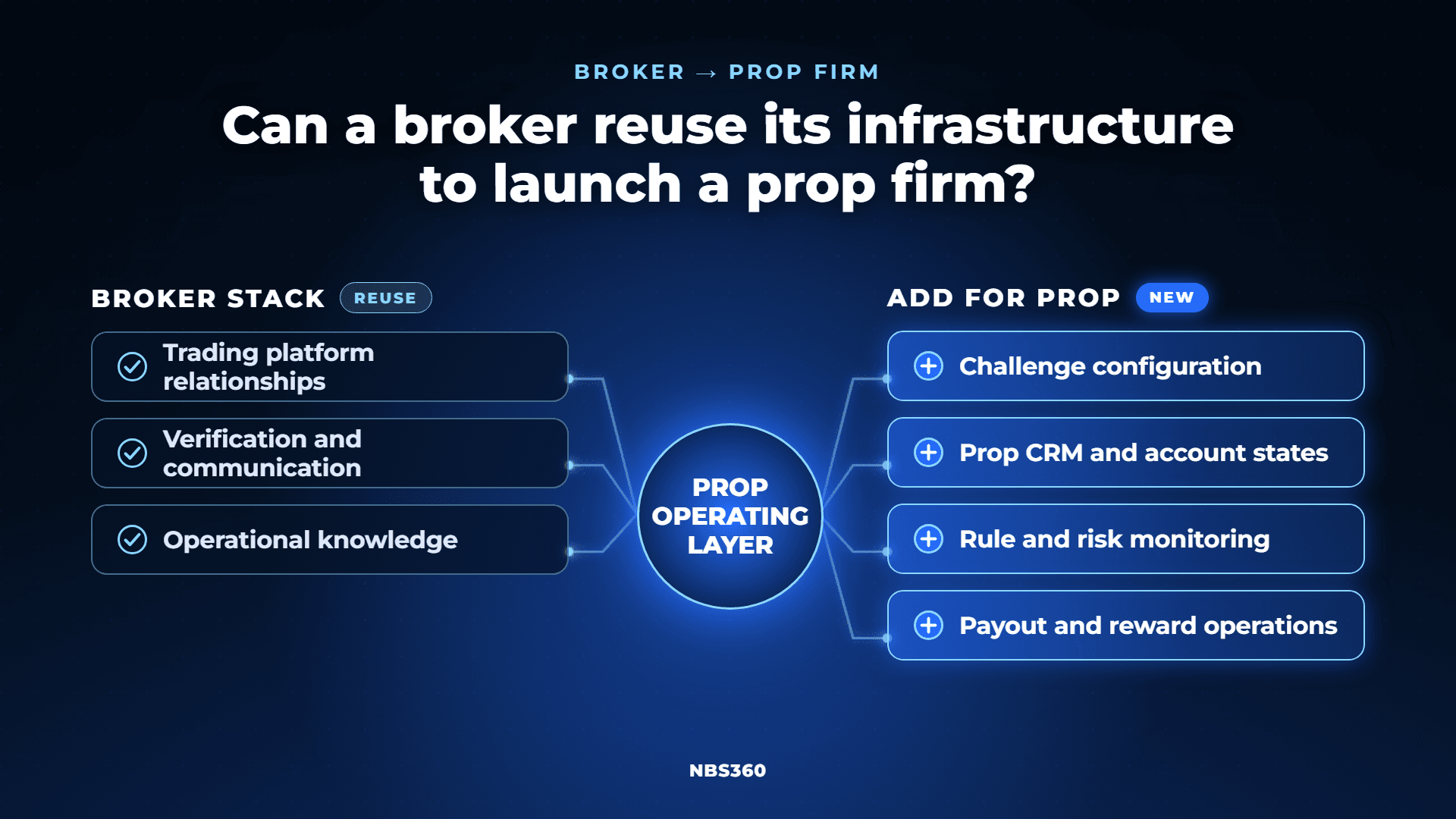
A broker evaluating this move, whether as a broker white label prop firm or a separate brand, should separate infrastructure that may be reused from workflows that must be added, adapted or contractually approved.
Start with the business model, not the software
A brokerage account and a prop evaluation account may use a similar trading interface, but they move through different commercial journeys.
A brokerage customer typically completes onboarding, funds an account and trades under the broker's account structure. A prop customer purchases an evaluation, receives an account governed by programme rules and progresses according to defined results. The firm then needs processes for funded stages, performance reviews and payouts or rewards.
Before reviewing vendors, map the prop journey from registration to final account status:
- Registration and purchase.
- Account creation and credential delivery.
- Evaluation against the selected rules.
- Pass, fail or review.
- Progression to the next stage or funded account.
- Payout request, review, decision and payment.
- Account continuation, reset or closure.
This map shows which existing components can support the new proposition and where a dedicated prop operating layer is required.
What a broker may be able to reuse
Reuse should be treated as a component-level decision. Confirm the technical fit, commercial permission and legal-entity scope for each service.
Trading platform relationships
An existing platform connection may support the instruments and trading experience required for a prop product. That can reduce integration work and give current customers a familiar interface.
However, the platform must also support, or connect to, prop-specific account creation, rule monitoring, status changes and reporting.
A trading platform provides the environment in which traders place orders. Running a prop business also requires challenge configuration, rule monitoring, account progression and payout management. Connecting these functions gives your team a clear operational view from the first purchase through to the funded stage.
NBS360's trading-platform infrastructure connects suitable CFD and futures environments to account lifecycle and back-office workflows. The exact fit depends on the chosen platform, instruments, geography and operating model.
Verification, communication and analytics tools
A broker may already have relationships for identity verification, email, SMS and analytics. These are candidates for reuse when the relevant provider allows the new use case and entity.
The integration still needs to place each result at the correct point in the prop journey. Verification status may affect onboarding, account progression or payout review. Communication triggers need to follow challenge events rather than brokerage deposit and trade events.
NBS360's integrations page describes connections across trading, payments, verification, communications and analytics.
Operational knowledge
Brokerage teams understand platform support, client communication, trading behaviour and operational controls. That experience gives them a strong starting point.
Roles still need to be assigned for prop-specific decisions: who owns rule configuration, who reviews unusual account activity, who approves funding progression, and who handles payout decisions and disputes.
What requires a dedicated prop workflow
Several core functions are specific enough that they should be designed around the prop proposition.
Challenge configuration and progression
The business needs a clear system for evaluation models, prices, account sizes, objectives, loss limits, trading-day requirements and promotions.
The same system must determine what happens when an account passes, fails or requires review. Manual status changes may work during testing, but they create operational risk as volume grows.
NBS360's challenge-management environment connects configurable models and rules with checkout, account creation, monitoring, communication and progression.
Prop CRM and account states
A broker CRM is usually centred on customers, deposits, trading accounts and commercial relationships. A prop operation must also distinguish users from evaluations, challenge stages, funded accounts and payout requests.
That difference affects filters, permissions, support workflows and reporting. A trader can hold several prop accounts at different stages, so a single customer status is rarely enough.
NBS360's prop-firm CRM separates trader records, challenge operations, funded accounts and payout requests within the back office.
Rule and risk monitoring
Prop risk controls need to translate product rules into account-level monitoring. Loss limits, objectives and trading requirements must be linked to the correct challenge version.
The team also needs a defined path from a signal to a documented review and decision. The brokerage's existing exposure or dealing tools may remain valuable, but they answer a different operational question.
NBS360's risk-management environment brings rule monitoring, account oversight, custom signals and payout readiness into the operator workflow.
Payout and reward operations
The firm must define when a request is eligible, which reviews are required, who can approve it, how the trader is informed and what happens to the account afterwards.
Payment execution is only one stage. Eligibility, verification, trading review, approval and provider confirmation should remain visible as separate steps.
Validate payments before promising the customer journey
An existing brokerage payment relationship should not be assumed to cover prop evaluation purchases or trader payouts.
Confirm the merchant description, legal entity, countries, currencies, chargeback process, prohibited uses and payout capabilities with each relevant provider. The same check applies to banking, card, crypto and verification partners.
NBS360's payments environment coordinates challenge purchases, crypto capabilities, fraud controls and payout operations with authorised partners where applicable. Transactions remain subject to verification, partner approval and relevant terms.
Build customer-facing promises only after those relationships and workflows are confirmed.
Decide how separate the prop brand should be
A broker can create a linked sub-brand or a distinct proposition. The right structure depends on audience, commercial strategy, provider requirements and appropriate professional advice.
From an operating perspective, define:
- Which customer and account data is shared.
- Whether support teams and service channels overlap.
- Which terms apply at each stage.
- How permissions separate brokerage and prop responsibilities.
- Which reports combine performance and which remain distinct.
- How the customer moves between brands, if that journey is offered.
Clear separation makes reporting, support and decision ownership easier even when both businesses use connected infrastructure.
Run a launch-readiness test
Before going live, test complete scenarios:
- A successful purchase and immediate account creation.
- A failed payment and duplicate purchase attempt.
- A rule breach and the correct customer notification.
- A passed evaluation moving to the next stage.
- A payout request with incomplete verification.
- A manual review triggered by unusual trading activity.
- A failed payout returning to an actionable queue.
- One user holding several accounts at different stages.
For each scenario, confirm the data source, automated action, responsible team member, customer message and audit trail.
The goal is a prop operation that uses the broker's existing strengths while giving evaluations, funded accounts and payouts the workflows they require.
NBS360 connects the customer journey, prop CRM, challenge management, risk, payments and platform integrations in one configurable operating environment. Explore the NBS360 platform or request a private demo to map which parts of your brokerage stack can connect to a prop proposition.